
HIL test bench for firmware: what is it for and when should you set one up?
A HIL (Hardware-in-the-Loop) bench tests the firmware on the real board, while simulating or driving its environment: sensors, interfaces, power supply, radio. Connected to continuous integration, it replays the same tests on every release. It becomes useful when manual testing no longer catches regressions before delivery.
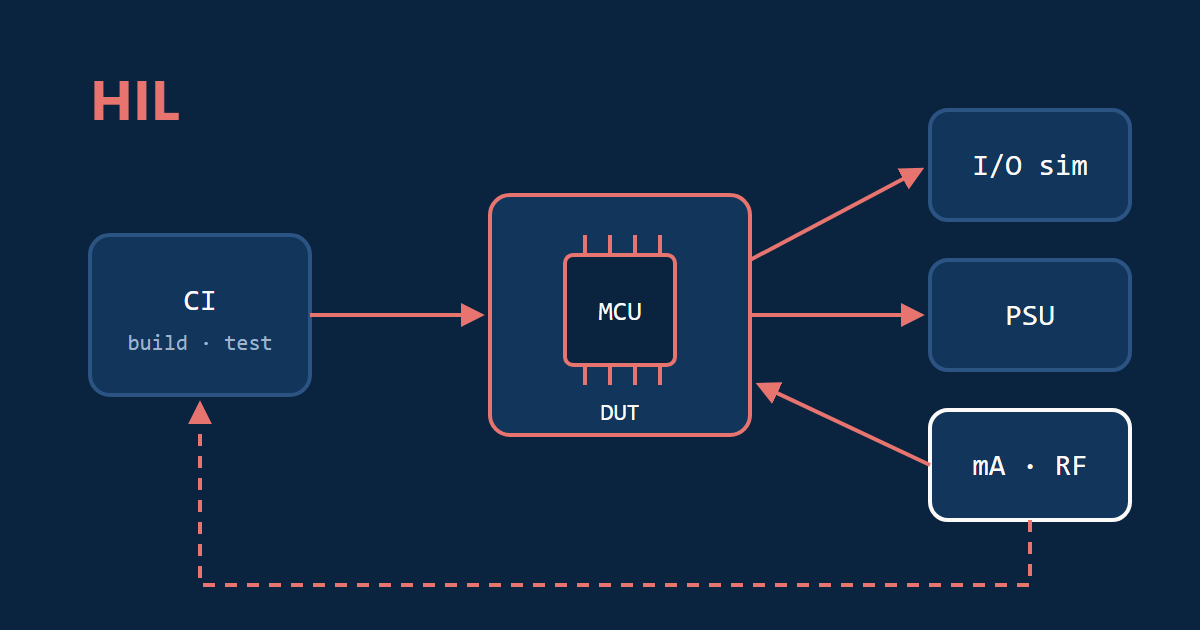
A HIL (Hardware-in-the-Loop) bench tests the firmware on the real board, while simulating or driving its environment: sensors, interfaces, power supply, radio. Connected to continuous integration, it replays the same tests on every release. It becomes useful when manual testing no longer catches regressions before delivery.
What does HIL mean?
HIL stands for Hardware-in-the-Loop: the real hardware is in the test loop. The firmware runs on its actual board, and the bench simulates or drives its surroundings. That is the difference with unit tests, which run on a computer, and with manual tests, done by hand by a technician.
What does a HIL bench contain?
It is designed for the product. It usually includes:
- the board under test, and a way to program it;
- interface or sensor simulators, to produce known inputs;
- a controlled power supply, to cut, restart or vary the voltage;
- measuring instruments: power consumption, signals, radio links;
- a computer that runs the tests and collects the results.
Some benches are limited to an interface simulator, others include complete pieces of equipment.
Which problems does it detect?
Those you only see with the real hardware: a timing fault, rising power consumption, a radio link that drops, an update that fails after a power cut. Above all it detects regressions: what worked in the previous release and no longer does.
How does it fit into continuous integration?
On every code change, continuous integration builds the firmware, loads it onto the bench and runs the tests. Results and measurements are archived with the release. The same tests are replayed each time, which makes releases comparable with one another.
When should you set one up?
When one or more of these signs appear:
- manual testing takes longer with every release;
- regressions reach your customers;
- the product exists in several variants or board versions;
- over-the-air updates must be reliable across a fleet of devices in the field;
- you need to show that the firmware was tested, for example in the compliance documentation.
The earlier the bench exists, the more it supports development. It can also be added to a product already in the field.
How we can help
Picodev's software factory designs custom HIL benches, driven by continuous integration, with analysis of the results and preparation of the fixes.
Related service: Software factory